Spacetime (space-time)

Time travel is the concept of moving between different points in time in a manner analogous to moving between different points in space, either sending objects (or in some cases just information) backwards in time to some moment before the present, or sending objects forward from the present to the future without the need to experience the intervening period (at least not at the normal rate).
Although time travel has been a common plot device in fiction since the 19th century, and one-way travel into the future is arguably possible given the phenomenon of time dilation based on velocity in the theory of special relativity (exemplified by the twin paradox), as well as gravitational time dilation in the theory of general relativity, it is currently unknown whether the laws of physics would allow backwards time travel.
Any technological device, whether fictional or hypothetical, that is used to achieve time travel is commonly known as a time machine.
Some interpretations of time travel also suggest that an attempt to travel backwards in time might take one to a parallel universe whose history would begin to diverge from the traveler's original history after the moment the traveler arrived in the past.
Around Two billion years ago a giant start exploded in a distant galaxy unknown to man till date, when it collapsed to a black hole it gave away measurable amount of energy our in a form of light. Due to it being billions and billions of light years (1 Light Years = 9,000,000,000,000 Miles) away from us; it's light reached us in 2003. This event then was called a Hypernova because of a violent end of a massive star many times bigger than our own Sun. However, when a star dies on its on and it's gravity crushed it-self is called a Supernova.
Hypernova
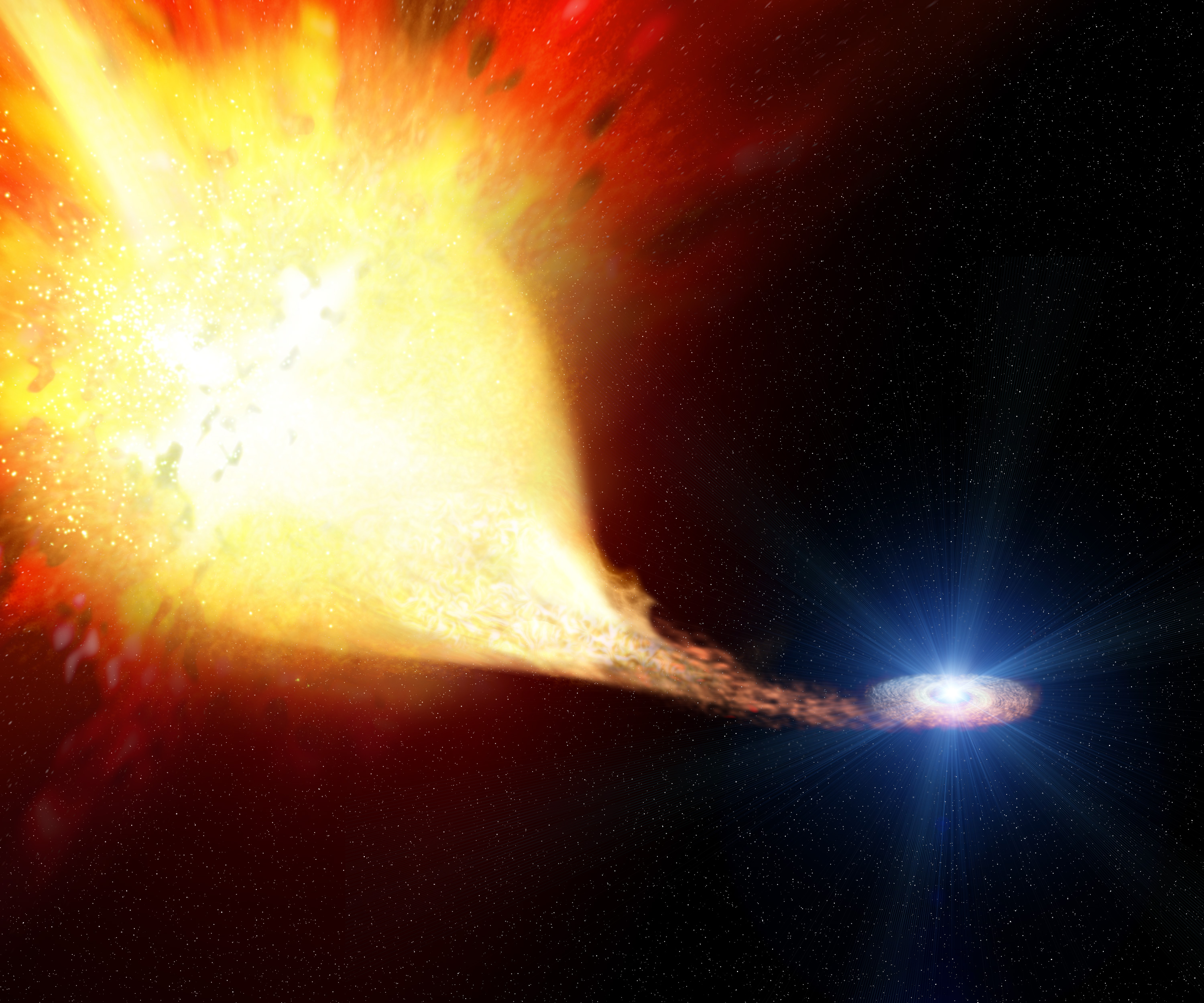
Supernova

